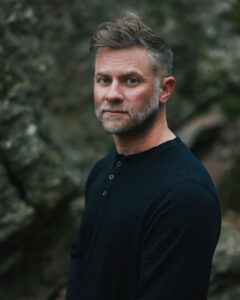
1. Tell us about yourself. Who is Jeremy Collins.
A dad. A husband. A storyteller. I got fortunate in high school and was introduced to rock climbing despite living far from any mountains. The curiosity and drive for climbing gave me a path that has lead me throughout my adult life, injecting a fierce loyalty to the places that inspire me. I am a multi disciplinary creative from filmmaking to books to large scale paintings to the smallest of drawings. I’m interested in any available opportunities to express my voice. I just wish I had the patience to learn to read sheet music.
2. What excited you about making art for WSFF?
Honestly it’s the aligned mission. My work lives at the intersection of nature, wild places and stories. I’ve been to the festival and every participant is there with curiosity, hope and a passion for the outdoors. These are my people.
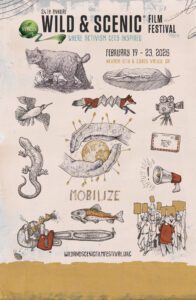
3. Can you walk us through the artwork you created for the 2026 Wild & Scenic Film Festival? What elements are represented and why?
I was so pleased that the WSFF team felt the montage idea was a fit. I heard “Mobilize” as a theme and immediately felt a single image wasn’t enough. I wanted to bring together various elements from my archive and newly drawn imagery for a collective voice. We are desperate for solidarity and that doesn’t just mean with people we align with politically or fundamentally. If there is any hope for peace in trying times, it’s in touching on our commonality. I find a lot of that in a love of wild and natural spaces.
4. Much of your artwork often revolves around nature. Can you tell us about your approach to painting/creating and why those forms are important to you and your work?
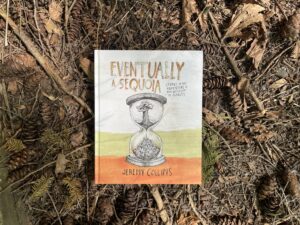
In my recent book, Eventually A Sequoia, the opening line on the very first page is pulled from western artist Maynard Dixon advising us “nature is your starting point.” Now this can mean a lot of things depending on the context, but for me- it is centering: nature is the starting point for how I spend my time, money and the source of my creative drive.
5. How does your location and sense of place impact your work?
I suppose it’s impossible not to be impacted by your location as a creative. Too often I find creatives sequester themselves and don’t go out in the world to feed their work. As artists we need to purposefully embed ourselves into society and nature to FEED our
creativity. To hide in a hole is to starve the creative mind. A great painter and teacher, Robert Henri says “The object isn’t to make art, it’s to be in that wonderful state which makes art inevitable.” If we are not having rich experiences, then what do we have to pull from creatively? Get out of the studio, get out of town, get out of the edges of society and have some damn experiences.
6. What do you think about the intersection of art and activism, and why might it be crucial in this moment?
In an era where creatives are often feeling defeated, now is the time where our work becomes focused. What does it look like to feel helpless? How does that translate in music, poetry, and art? Or film? When everything is falling apart, it is art that lets us see what is real. To create is a refuge, a coping mechanism for understanding and a space to process emotions and our response to them. For some of us it is just therapy, for others a weapon. Art has the power to influence, spark imagination and sharpen understanding. In times of duress throughout history, activism driven art is how we understand what we are up against. The creative response to struggle and chaos is a proven way we find our solidarity.
7. Our Festival’s tagline is “Where activism gets inspired.” What inspires you?
Watching people enjoy places I love for the first time. A good story. The unexpected hoot of an owl. Perfect days on rock, thousands of feet off the ground. The sound of gravel and dirt interacting with my bike tire. The reckless abandon of children.
8. What does our theme this year, “MOBILIZE” mean to you, and how is it represented in this piece?
It means ALL OF US who find ourselves concerned about the state of things are important. It’s easy to be dismayed and feel helpless, but our voices no matter how small and seemingly insignificant have merit. I have a friend who told me “I’m willing to fight for what I believe in with everything but my body”. He was indicating he wasn’t willing to go to protests. And that’s okay. Different things need different energy and approaches. I mobilize via storytelling and art. Some folks mobilize by local volunteering. Some folks mobilize by lobbying or even finding their way into public office. Even getting out and enjoying the beauty of our natural spaces is a form of mobilizing. Recreating can even be resistance. It is our right and our joy to play in the outdoors. Public Lands are threatened now more than ever and if we don’t purposefully make time to enjoy them then why are we even fighting for their protection?
9. How can people see more of your artwork? Is there anything else you’d like to share with our audience?
Currently my creative energy is heavily directed by my book tour. I put a lot of energy into asking the question “what do we need right now”? My answer in a post Covid, politically tumultuous world is space to gather with experiences that are real. The traveling installation is the physical manifestation of that answer. In some ways it makes no sense, but the response of the audiences affirms that we are desperate for TEXTURE- things and experiences that are real. A place to laugh, cry and nod our heads together.